Showing posts with label History. Show all posts
Showing posts with label History. Show all posts
Tuesday, October 27, 2015


Tuesday, October 20, 2015
6000 year old Lord Ram and Hanuman carvings in Silemania Iraq
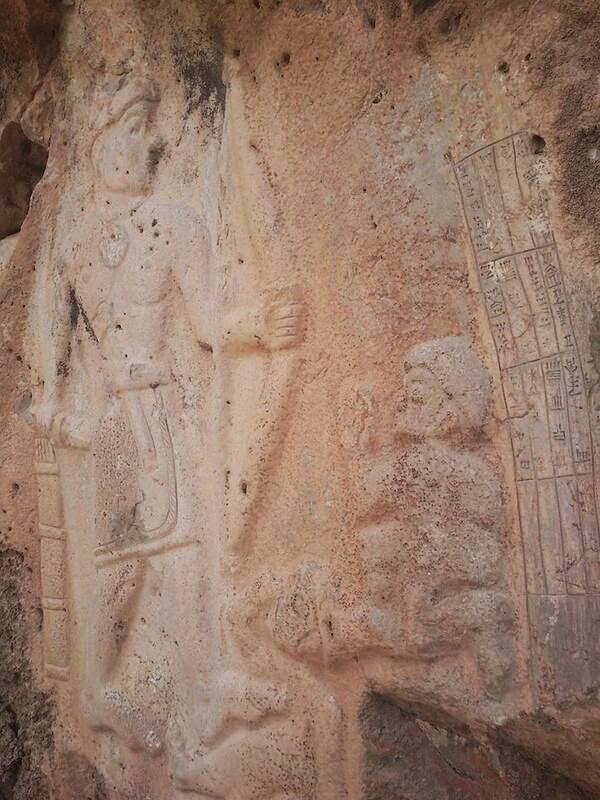
AN ANCIENT RAM-CHAPEL IN SUMER
One of the major triumphs of modern archaeology was the hair-raising discoveries of Sir Leonard Woolley at Ur. Amidst the ruins of Ur, he unearthed a Ram-chapel but totally missed its relevance in world history. This crucial finding not only bridges the wide gaps between Indian tradition and archaeology but also unfolds the historic bonds that once united ancient India, Iran and Sumer. Ram-Sin of (Larsa) to whose memory this chapel was dedicated must have been Rama of Valmiki. The name Ararama of Larsa may be an echo of Rama. This Ram-Chapel of Ur is the earliest known memorial to the great Rama and may have been erected by Dilmun merchants who resided nearby. Dilmun was always mentioned in the Sumerian texts together with Magan and Melukkha and it is possible that these three states were somehow allied to each other.
RAMA, BHARATA & LAKSHMANA IN SUMER
The Cambridge Ancient History[xvi][iii] which is usually not considered as a sourcebook for Indian history by writers like Romila Thapar contains priceless information relevant to Indian ancient history. In the highly authentic Sumerian king list appears such hallowed names as Bharat (Warad) Sin and Ram Sin. As Sin was the Moon god Chandra Ram Sin can be seen to be same as Rama Chandra. Bharat Sin ruled for 12 years (1834-1822 BC), exactly as stated in the Dasaratha Jataka. The Jataka statement, “Years sixty times hundred, and ten thousand more, all told, / Reigned strong-armed Rama”, only means that Rama reigned for sixty years which agrees exactly with the data of Assyriologists. Ram Sin was the longest reigning monarch of Mesopotamia who ruled for 60 years. The mention of the father in the inscriptions of both Warad Sin and Ram Sin is noteworthy and may point to a palace intrigue. Joan Oates is not aware of the Ramayana but writes with great insight (p. 61) that Warad sin was manoeuvred to the throne by his father. In Mesopotamia, a prince normally became king only after the death of his father. Lakshmana, mentioned the Bible as Lakhamar, ruled as a great king.
Thursday, September 3, 2015
The BBC and an anti Hindu History
I feel uneasy whenever the BBC decides to broadcast programs on Ancient India, two recent broadcasts reflect the general anti Hindu bias built into the BBC. Firstly "Genius of the Ancient World by Bettany Hughes on the Buddha and "Treasures of the Indus" with Dr Sona Datta on the History of Pakistan. Both avoid talking of the influence of the Sarasvati civilization which dates some 9000 years ago. I would use the term Aryan but that has problems with Europeans since WWII. Bettany does a whole episode on the Buddha without discussing the Hindu culture which produced the Buddha, though plenty Hindu imagery was used. Dr Datta goes on to extol the virtues of the Buddha (him again) Greece and Islam in the 5000 year history of "Pakistan". No mention of the Mahabharat Vedas Sarawati or Aryans (Hindus). I made a similar point to Dr Miles Russell, Senior Lecturer In Archaeology at Bournemouth University, on his article about the Swastika for the BBC Magazine, he replied, he wasn't given the space, and suggested that I write to the BBC myself. I am very tempted to do just that
Tuesday, March 31, 2015
Decolonising Maths education remove Church ideology
A cocktail of practical value and religious propaganda can have obnoxious consequences. Post-colonisation, Maths teaching in India blindly apes Western practices — a pity because most of that school Maths actually originated in India. Europeans also imported it for its practical value. However, contrary to popular belief, the understanding of Maths is not universal. Indian ganita accepted empirical proofs. This differed from the European understanding of Maths as metaphysics. Hence, over centuries, the West adapted the imported Indian Maths to fit their metaphysics, which was linked to church theology. During colonisation, the West exported back this religiously coated mathematics, which is now taught globally.
"Maths was considered especially suited to arouse the eternal soul since it was believed that it contains eternal truths."
Maths was considered especially suited to arouse the eternal soul since it was believed that it contains eternal truths. The belief in eternal truths in turn led to the Western belief that Maths is “perfect.” It was further thought that this perfection could be achieved only through metaphysics and not empirically. Today, Maths is 100 per cent metaphysics.
Imperfect Maths
The belief that Maths is perfect is certainly not universal. Indian tradition accepted Maths as non-eternal and imperfect. Most practical applications of Maths today, such as sending a spacecraft to Mars, are done using computers which do Maths “imperfectly.”
The belief that Maths is perfect is certainly not universal. Indian tradition accepted Maths as non-eternal and imperfect. Most practical applications of Maths today, such as sending a spacecraft to Mars, are done using computers which do Maths “imperfectly.”
Teaching Western metaphysics spreads other biases. All systems of Indian philosophy, without any exception, accept the pratyaksa, or empirically manifest, as the first means of proof. This also applies toganita. Science and engineering too prefer empirical proofs to metaphysics. So if Maths is done for its practical applications, it is better to accept empirical proofs in the subject. But present-day Maths teaches such proofs, hence all Indian philosophy, is “inferior.”
Does any of this make a difference to 2+2=4? Yes. Why is 2+2=4? Putting together two pairs of apples to show four apples is erroneous on formalism which disallows reference to the empirical. Formalism posits that 2+2=4 can be “rigorously” deduced only metaphysically from, say, Peano’s axioms. Most people don’t know how to do that or even what Peano’s axioms are. Thus, most Western educated never even properly learn 2+2=4. Since they are taught alongside that all other systems are inferior, they are compelled to rely blindly on Western authority for everything. This is by design. To put an end to this mental enslavement through indoctrination, education must be decolonised. The new government ought to focus on that.
Sunday, February 15, 2015
8 Indian Anti Hindu Intellectuals
1. Angana Chatterji
Books:
Career Summary
Books:
Books : Yes, We Can! Book series. (Books on moral science)
Notable articles:
Pronouncement:
In June 2002, he testified before the US Commission for International Religious Freedom (USCIRF) in Washington. Gujarat riots
Career Summary
Notable books:
AT the Policy Institute for Religion and State (PIFRAS) held a South Asia Conference, sponsored by “United Methodist Board of Church and Society and the National Council of Churches of Christ in the USA” John Dayal, as a participant, had contended that “minorities could not count on the Indian state to protect them, or to prosecute crimes committed against them.”
Career Summary:
Books:
Labelled the Ramayana as a sectarian text that spoke of a clash between Shaivites and Vaishnavites because Ravana is a follower of Shiva and Rama is believed to be an avatar of Vishnu. He also dubbed the Puranas as sectarian texts.
Career Summary:
Books:
Books:
Books:
Books:
- Violent Gods: Hindu Nationalism in India’s Present; Narratives from Orissa
- Land and Justice: The Struggle for Cultural Survival in Orissa
- In Gujarat, Hindu extremists killed 2,000 people in February-March of 2002.
- Grassroots democracy threatens upper-caste Hindu dominance and contradicts elite aspirations.
- In Orissa, egregious infringements of human rights are taking place with the disintegration of Adivasi and other non-Hindu cultures through their hostile incorporation into dominant Hinduism.
- After being nominated Chief Minister of Gujarat in October 2001, Mr. Narendra Modi incorporated the teachings of Hindutva in his governance of Gujarat. .
- India’s contrived enemy in Kashmir is a plausible one — the Muslim “Other,”
- Disenfranchised caste and other groups, Assamese, Nagas, Sikhs, Dalits (erstwhile “untouchable” peoples), and Muslims from Kashmir
Career Summary
- Narmada Bachao Andolan (NBA, “Save the Narmada Movement”).
- Forum of Indian Leftists (FOIL), , Friends of South Asia (FOSA)
- PhD in the Humanities from California Institute of Integral Studies (CIIS).
- United Nations Bodies, the European Parliament Human Rights Subcommittee, United Kingdom Parliament, and United States Congressional Commissions and Task Forces.
- Chatterji is the Co-chairman of the Research Project on Armed Conflict and People’s Rights at the Center for Nonprofit and Public Leadership, University of California at Berkeley
- Chatterji co-founded the International People’s Tribunal on Human Rights and Justice in Indian-administered Kashmir with Parvez Imroz in 2008 and served as Co-Convener from April 2008 to May 2012.
- Angana Chatterji was suspended from CIIS on 19 July, 2011 and on 25 October the CIIS Academic VP has recommended her termination. This was due to her links with Ghulam Nabi Fai, an ISI mole in the USA.
Books:
- Ancient Indian Social History: Some Interpretations, 1978
- Cultural Pasts: Essays in Early Indian History, 2003; Oxford University Press
- Cultural Transaction and Early India: Tradition and Patronage
- Dissent in the Early Indian Tradition
- Early India: From Origins to AD 1300
- Early India: “Some settlements in the north-west and Punjab might have been subjected to raids and skirmishes [by the Aryans], such as are described in the Rig Veda…
- “I do not see the medieval period as one where the Muslims are the conquerors.
- After graduating from Punjab University, doctorate School of Oriental and African Studies, the University of London in 1958. Professor of Ancient Indian History at the Jawaharlal Nehru University, New Delhi.visiting professor at Cornell University, the University of Pennsylvania, and the College de France in Paris.
- General President of the Indian History Congress in 1983 and a Corresponding Fellow of the British Academy in 1999. members of t Delhi Urban Heritage Foundation due to her proximity with Najeeb Jung, Lt. Governor of Delhi.
- believes in the discredited theory of Aryans invading India.
- non-existence of a temple in the disputed site of Ayodhya.
- Romila Thapar’s named in the factual expose by Arun Shourie in Eminent Historians: Their technology, their line, their fraud. Exposed by Sita Ram Goel, Arun Shourie and similar scholars the fact that she does not know Sanskrit.
Books : Yes, We Can! Book series. (Books on moral science)
Notable articles:
- Let Us Not Be Naive About Naveen Patnaik
- Can the election on April 16 in the Kandhmals ever be free and fair?
- Vibrant Gujarat: Lies, Half Truths and Illusions
- India: Gujarat Government Continues With Communal Agenda
- Gujarat Carnage: Seven Years On . . . Seven Major Concerns and More
Pronouncement:
In June 2002, he testified before the US Commission for International Religious Freedom (USCIRF) in Washington. Gujarat riots
Career Summary
- Father Cedric Prakash is a Jesuit Priest of the Gujarat.
- He graduated from St. Xavier’s College in 1972.
- AICUF (All India Catholic University Federation) in Chennai World Council of Youth.
- Director of PRASHANT, the Ahmedabad-based Jesuit Centre for Human Rights, Justice and Peace
- critic of Narendra Modi, in collaboration with John Dayal and Teesta Setalvad.
- associated US-based think tank, Ethics and Public Policy Center (EPPC),activistLocal Capacities for Peace Project at the Harvard University.
- Cedric Prakash was also invited to Luxembourg in 2002 and later, to London for discussions with the European Union and the Foreign and Commonwealth Office of the British Government.
- The Kabir Puraskar by the President of India in 1995.
- The Rafi Ahmed Kidwai Award by the Indian Muslim Council (USA) in June 2003.
- Chevalier de la Legion Honneur (Knight of the Legion of Honour) by the President of the French Republic in July 2006.
- Minority Rights Award from the National Minority Commission, Government of India in December 2006
- The Human Dignity Award from the Diocese of Ahmedabad in February 2010.
Notable books:
- Human Rights: A Close Look.
- Justice & Peace Commission, All India Christian Council: Gujarat 2002: untold and re-told stories of Hindutva lab.
- John Dayal : A matter of equity: freedom of faith in secular India.
AT the Policy Institute for Religion and State (PIFRAS) held a South Asia Conference, sponsored by “United Methodist Board of Church and Society and the National Council of Churches of Christ in the USA” John Dayal, as a participant, had contended that “minorities could not count on the Indian state to protect them, or to prosecute crimes committed against them.”
Career Summary:
- Closely associated with the activities of the Sonia Gandhi-led National Advisory Council (NAC), which was instrumental in several nation-wrecking legislations.
- National Integration Council,a witness to the Tom Lantos Human Rights Commission (TLHRC)’s hearingtitled “Plight of Religious Minorities in India”
- Communal Violence Bill.
- supported, sponsored, nurtured and protected by the Congress party.”
Books:
- Empire of Knowledge: Culture and Plurality in the Global Economy
- The History of History: Politics and Scholarship in Modern India
- Empire and the Dream-Work of America.
- Introducing Hinduism
Labelled the Ramayana as a sectarian text that spoke of a clash between Shaivites and Vaishnavites because Ravana is a follower of Shiva and Rama is believed to be an avatar of Vishnu. He also dubbed the Puranas as sectarian texts.
Career Summary:
- He was a Fellow of the Japan Society for the Promotion of Science at the National Museum of Ethnology (Minpaku).
- Presently associate professor of history at UCLA.
- Earned his B.A. and M.A., both in 1982, from the Humanities Center at The Johns Hopkins Universityand wrote his Master’s thesis on Emerson and Indian philosophy.
- Studied cinema in Australia and India on a Thomas J. Watson Fellowship before commencing his graduate studies at the University of Chicago, where he was awarded a PhD with Distinction from the Department of South Asian Languages and Civilizations in 1992.
- Was William Kenan Fellow in the Society of Fellows in the Humanities at Columbia University in 1992–93.
- In his blog titled Lal Salam (Red Salute, making no secret of his commitment to Communism), he describes himself thus: His views on American foreign policy and the pax Americana have earned him a place in David Horowitz’s book on the 101 ‘most dangerous’ professors in America today, while his critiques of extreme Hindu nationalism have made him a target of Hindutva venom in the US. These are reliable indicators, to his mind, that he is performing some useful public service, and that academics and scholars must remain vitally engaged in the wider public domain.
Books:
- Cultivating Humanity
- Sex and Social Justice
- From Disgust to Humanity: Sexual Orientation and Constitutional Law
- Plato’s ‘Republic': the good society and the deformation of desire
- The clash within: democracy and the Hindu right
- The new religious intolerance: overcoming the politics of fear in an anxious age
- In India, the perpetrators of violence are not Muslims (who are usually poor and downtrodden, but not involved in perpetrating violence, except in the special case of Kashmir) but Hindus who sought ideology in Fascist Europe and who model their stance on European anti-Semitism of the 1930s.
- A Hindu nation is not a benign establishment like the Lutheran Church of Finland.
- The people who spoke Sanskrit almost certainly migrated into the subcontinent from outside, finding indigenous people there, probably the ancestors of the Dravidian peoples of South India. Hindus are no more indigenous than Muslims (The clash within: democracy and the Hindu right)
- What has been happening in India is a serious threat to the future of democracy in the world.
- current Ernst Freund Distinguished Service Professor of Law and Ethics at the University of Chicago,
- Committee on Southern Asian Studies, and a board member of the Human Rights Program.
- philosophy while at Harvard University,
- Amartya Sen with whom she shared an intimate relationship,
- She does not have any qualification or training in archeology, Sanskrit, geology, or metallurgy, yet writes with authority about the dating of the Vedas.
Books:
- The Poorer Nations: A Possible History of the Global South
- The Darker Nations: A People’s History of the Third World
- Arab Spring, Libyan Winter
- Uncle Swami: Being South Asian in America
- caste system that is Aryan in origin,the Dalits or Untouchables.
- . Early conversions are not by the sword but by the merchants .historian Romila Thapar’s superb book ‘Samantha: The Many Voices of a History’ (Penguin, 2005). …..
- Vijay Prashad is the George and Martha Kellner Chair in South Asian History and Professor of International Studies, at Trinity College in Hartford, Connecticut.
- Prashad is one of the founding fathers of the FOIL and is the author of several books regarding South Asia, and has often written articles and papers on US imperialism and capitalist hegemony and impacts of this across the world.
- In case of India he has often supported Kancha Ilaiah who made his academic repute by tossing out ill-informed interpretations of Indian mythology, presenting them as ‘Aryan-Brahminical’ conspiracies against the down-trodden, while simultaneously claiming to be a follower of the rationalist Ambedkarite school of thought.
Books:
- Breaking the Spell of Dharma and Other Essays
- Prophets Facing Backward: Postmodern Critiques of Science and the Hindu Nationalism in India.
- Postmodernism And Religious Fundamentalism: A Scientific Rebuttal To Hindu Science
- The God Market
- The roots of “Vedic science” can be traced to the so-called Bengal Renaissance, which in turn was deeply influenced by the Orientalist constructions of Vedic antiquity as the “Golden Age” of Hinduism. Heavily influenced by German idealism and British romanticism, important Orientalists including H.T. Colebrooke, Max Mueller and Paul Deussen tended to locate the central core of Hindu thought in the Vedas, the Upanishads and, above all, in the Advaita Vedanta tradition of Shankara. Despite the deeply anti-rational and idealistic (that is, anti-naturalistic) elements of Advaita Vedanta, key Hindu nationalist reformers – from Raja Ram Mohun Roy and Bankim Chandra Chatterjee to Swami Vivekananda – began to find in it all the elements of modernity. Vivekananda took the lead in propagating the view that the monism of Advaita Vedanta presaged the future culmination of all of modern science. Since modern science denied the role of any supernatural force outside nature, Vivekananda claimed that only Vedantic monism was truly scientific for it treated God as an aspect of nature and did not invoke any force external to nature…. (Prophets Facing Backward: Postmodern Critiques of Science and the Hindu Nationalism in India)
- The Hindutva literature is replete with glowing tributes to Hindu “renaissance”, which they claim to be similar to the European Renaissance that ushered in the modern age in the West. What they forget is that the Renaissance in the West re-discovered the humanistic and naturalistic sources of the Greek tradition that had been overshadowed by the Catholic Church – the Renaissance humanists rediscovered this-worldly philosophy of Aristotle and critical-realist Socrates over the other-worldly philosophy of Plato. The neo-Hindu “renaissance”, in contrast, re-discovered the most mystical and anti-humanistic elements of the Vedic inheritance – Advaita Vedanta – that had always overshadowed and silenced the naturalistic and scientific traditions in Hinduism and Buddhism. Neo-Hinduism is no renaissance, but a revival. There is no denying that the neo-Hindu “discovery” of modern science in ancient teachings of Vedas and Upanishads had a limited usefulness. Since they had convinced themselves that their religion was the mother of all sciences, conservative Hindus did not feel threatened by scientific education. As long as science could be treated as “just another name” for Vedic truths, they were even enthusiastic to learn it….. (Prophets Facing Backward: Postmodern Critiques of Science and the Hindu Nationalism in India)
- Far from being considered the crown jewel of Hinduism, yogic asanas were in fact looked down upon by Hindu intellectuals and reformers—including the great Swami Vivekananda—as fit only for sorcerers, fakirs and jogis…. “Not as Old as You Think… …nor very Hindu either. There is telling evidence to debunk this nationalistic myth”, Open The Magazine, Online Edition,
- Meera Nanda is an Indian writer, historian and philosopher of science with a PhD from Rensselaer Polytechnic Institute. She was a John Templeton Foundation Fellow in Religion and Science (2005–2007).
- From January 2009, she became a Fellow at the Jawaharlal Nehru Institute for Advanced Study, in the Jawaharlal Nehru University for research in Science, Post-Modernism and Culture besides being a visiting faculty of history and philosophy of science at Indian Institute of Science Education and Research, Mohali.
- The bulk of her writings is a critique towards any attempt to study Hinduism in the light of science. Interestingly as she was associated with the John Templeton Foundation, she did praise the Protestant work ethic whereas the notion of Practical Vedanta is criticized.
Wednesday, February 26, 2014
Hindu Dharma Marriage and Religion
There can be much confusion if we adopt wrong names and labels to a topic and that is the case with Hindus or Indians neither term is indigenous to the continent both have been introduced by invaders the first by Muslims the second by the British. Nowhere in the entire 10000+ years of known Hindu literature do these words arise. The indigenous term is Aryan, meaning a noble learned person. Today throughout the world we see Aryan customs being practiced, recent archaeological evidence debunks the aryan invasion theory, that some how they came from outside India. Aryans spread out from an area covered by Pakistan Punjab and Gujarat through which the ancient Saraswati river flowed called the Saraswati civilisation

Hindu dharma is the culture of the Aryans the primary language being Sanskrit, the mother of all European languages. Two of the sixteen sanskars or customs are naming a new born baby and marriage. Where ever they occur in the world, the roots and logical explanations lie with the Aryans. Aryans do not discuss other religions because they predate them, and the fact that today's Hindu culture has a continuous unbroken link to the beginning of human civilization is a wonder in itself, and is rightly considered a way of life rather than a religion. A religion has a founder, a book and a time when it was set down none of these apply to the Hindus. They also discuss how the pagans or kafir are to be dealt with in great detail, this in-turn lead to the destruction of many pagan temple, in Rome this is well documented, the pre-Christian Romans, I would best describe as Hindus of today did not require followers to have faith in any one book or person. The Victorian British tried to make sense of this by making the Bagvad Gita the Hindu holy book, when ruling India, and have left many damaging laws and customs not of Aryan logic. Their efforts at conversion lead them to study Sanskrit and demean Brahmin's the carriers of Aryan knowledge from the time since the discovery of language.
The English term "NAME" and custom is of Sanskrit origin, made of two word "NAH" and "MAHMA", NAH is NO and MAHMA is ME both are sanskrit. Therefore NAME means NOT ME but only God, or a human has no existence but for God, names are also from divine deities and religious terms, to remind the person of his true nature that of Atman (soul) in relation to God.
Similarly sex and its ritual custom of marriage are rooted in Aryan custom. Religions do not have a logical explanation for this custom. Logic is one thing Aryans relied on and ended up giving the world maths and the Hindu numerals their ultimate logic tool. Aryans studied both Sanskrit and Math in the same vain this had two attributes, it made Sanskrit a mathematically precise language and also there was no separation between science and Hindu "religion". An example is of the Shiva at CERN atomic labs in Switzerland today. The Hindu
With the advent of religions, when Aryan converted forcibly in most cases, makes Shri Chawla's case today's world very brave. His task is complicated having to explain to people of faith who in all cases adopt Aryan culture but have lost sight of their origins. In Christianity the English have a saying "tied the knot" which does not occur in a church but seen in the pagan Hindu ceremony. The Aryan term for divorce being "untied the knot". The other is the wedding ring placed on the second finger. That figure is connected to the heart in Ayurveda, heart from the sanskrit "hirdya". It is this ring Hanuman took from Sita, while in captivity and brought it to Ram as a message to say she was still his wife. The Church sanction marriage as ordained by God and is somehow holy but omit sex which is at the very heart of that union. Of the four aims of an Aryan, sex is one known as Kama, in yoga it is often sexual union and the science of Tantra alludes to that. The concept in tantra is interplay of shiv (male) and shakti (female) energy. The concept of male and female arise from this originally, in Adam and Eve and the serpent represents sex as it does in yoga. The union of male female is considered the nearest one attains to godly bliss. Osho deals with this aspect in his book "Krishna the Man and his Philosophy" Hindus today bear the scars of invasions by religions and the need is to rediscover the faded Aryan culture which is termed "Sanatan" (eternal) for good reason.
Sunday, March 24, 2013
True Indian History
Introduction: roots of distortion
India gained independence from the British in 1947, or more than fifty years ago. But intellectually and educationally India continues be a European colony. This is because, during the first forty years of her existence as a free nation, the Congress Party and the intellectual establishment, continued to encourage colonial institutions and thinking. The result today is that there is an English educated elite that identifies itself more with the West than with India and her ancient civilization. And the Congress Party, especially after the death of Sardar Patel, has identified itself more with foreign values rather than Indian values. The Communists, who have always been hostile to Indian nationalism, have now joined hands with anti-national forces, which are fiercely anti-Hindu. This is reflected in the attitude and behavior of the English educated intellectuals, including the media.
The signs of this are everywhere � from hostility to Sarasvati Vandana and the Pokharan nuclear tests to begging a European woman of no experience or service to the nation, to rule the country. As a result, this colonial holdover consisting of the Congress, the Communists and the Leftist intellectual class (including the media) have come together to perpetuate anti-national values and interests. This naturally makes them intensely anti-Hindu. It views with fear anything that has even a suggestion of nationalism rooted in Indian history and tradition.
Since Indian nationalism can only exist as a product of the Hindu Civilization, these forces hostile to Hinduism have combined to oppose the rise of national awareness that is now sweeping the country. The result is that they will go to any length to give a negative picture of India and her past. The first step in this is to distort Indian history. Fortunately for them, most of the distortion had already been done for them by the British, and their successors during the Congress rule. So all they had to do was to continue with the colonial version of Indian history. As Swami Vivekananda pointed out more than a century ago:
"The histories of our country written by English [and other Western] writers cannot but be weakening to our minds, for they talk only of our downfall. How can foreigners, who understand very little of our manners and customs, or religion and philosophy, write faithful and unbiased histories of India? Naturally, many false notions and wrong inferences have found their way into them.
"Nevertheless they have shown us how to proceed making researches into our ancient history. Now it is for us to strike out an independent path of historical research for ourselves, to study the Vedas and the Puranas, and the ancient annals of India, and from them make it your life's sadhana to write accurate and soul-inspiring history of the land. It is for Indians to write Indian history."
As Swami Vivekananda pointed out, the goal of the British was to weaken the Indian spirit, particularly the Hindu spirit, because the nationalist movement in India was mainly a Hindu movement. The nationalist movement, which rose to great heights during the Swadeshi Movement following the Partition of Bengal, lost its direction and focus in 1920 when Mahatma Gandhi sacrificed Swaraj for the sake of the Khilafat. This in turn led to the anti-Hindu orientation of the Congress under Jawaharlal Nehru. This was soon joined by the Communists, who worked hand-in-glove with the Congress. The Communists now are little more than camp followers of Sonia Gandhi and her party.
So it is in the interests of these anti-national forces to keep alive the colonial version of Indian history. Thanks to the domination of the Indian political scene by the Congress, Communist intellectuals and fellow travelers were able to dominate the intellectual scene also. As a result, the colonial version of history continues to be taught in Indian schools and colleges. This has led to gross distortions in the history being taught in Indian schools and colleges. These distortions may be classified as follows:
Distortion of ancient history through the �Aryan invasion� and the Aryan-Dravidian wars, presenting the Vedic Age as an �age of conflict�
Distortion of the Medieval history, by whitewashing the Islamic record and presenting it as the 'age of synthesis'.
Distortion of the period of the Freedom Struggle, by whitewashing Congress blunders and suppressing the contribution of the revolutionaries, Sardar Patel and Subhas Bose.
Distortion of post-independent India, by whitewashing the monumental blunders of Pandit Nehru and his successors to bring about dynastic rule under the Nehru-Gandhi dynasty at the cost of national interest.
It is worth taking a brief look at each one of them, beginning with the ancient period. The first point to note that it was the ancient period that gave India both its unity and its sense of the nation. The Medieval period was a Dark Age, during which the Hindu civilization was engaged in a desperate struggle for survival. In addition, the forces of medievalism contributed nothing to Indian nationalism. They acted as a negative force and held back progress, taking the country into a Dark Age. They continue to act as a check against progress by holding on to medieval ideas and practices.
The important point to note is that the ancient period was an age of synthesis, when people of different viewpoints like the Vedic, Tantric, Buddhistic, Jain and other sects lived in relative harmony. There was also free exchange of ideas and unfettered debate. The Medieval period was the age of conflict when Hindu society was engaged in a desperate struggle for survival against the onslaught of Jihad � something like what is happening in Kashmir today. What the Congress sponsored Leftist (�secularist�) historians have done is to exactly reverse this. They have said that the ancient period was an age of conflict between Aryans and non-Aryans, while trying to portray the Medieval period � dominated by Jihad (or religious wars) � as a period of synthesis.
Ancient India: age of freedom and synthesis
History books today begin with the Aryan invasion of India, which is said to have taken place in 1500 BC. Students are told that the ancient civilization of the Indus Valley or the Harappan Civilization was Dravidian that was destroyed by the invading Aryans. According to this theory, the language of the Harappan seals, which contain a good deal of writing, is some form of Dravidian language, unrelated to Sanskrit. There are nearly 4000 of these with writing on them, but until recently, no one could read them. Recently, the great Vedic scholar N. Jha made a major breakthrough in deciphering it. Following the breakthrough, Jha and I have read and published the writing on nearly 2000 seals. (We have read many more that are yet to be published.) The language of the seals is Vedic Sanskrit. This means the Harappan Civilization was Vedic.
This also means there was no Aryan invasion and no Aryan-Dravidian conflicts either. In Sanskrit, �Aryan� simply means cultured and not any race or language. I am myself a so-called Dravidian who speaks Kannada. Kannada, like all South Indian languages, is heavily influenced by Sanskrit. South Indian dynasties going back time immemorial called themselves �Aryas� because they were followers of the Vedic culture. South has always been a stronghold of Vedic culture and learning. Sayana, probably the greatest Vedic scholar of the last thousand years was a South Indian. (He was the brother of Vidyaranya, who helped Harihara and Bukka found the great Vijayanagara Empire.)
The idea of Aryans and Dravidians as mutually hostile people was created during the colonial period, in which Christian missionaries played an active role. It was part of the British policy of divide and rule. Bishop Caldwell was probably the most influential Dravidian scholar. When criticized for his theories, he defended them "as not only of considerable moment from a philological [linguistic] point of view but of vast moral and political importance." By �moral and political�, he meant Christian missionary and British colonial interests.
This shows that one of the main forces behind the Aryan invasion theory, and of education policy in general, was the conversion of Hindus to Christianity to make them accept British rule. According to the Aryan invasion theory, the Vedas and Sanskrit language were brought by these Indo-European invaders and not native to India. (This is now demolished by science and also the decipherment of the Harappan writing.) Using this false theory, the British could claim that India had always been ruled by foreign invaders � first the Vedic Aryans, and later the Muslims. The British claimed to be Aryans (as Indo-Europeans) and therefore only the latest rulers of India, but related to their own ancient Aryans who also were foreign invaders! Christian missionaries took advantage of this by enjoying the patronage of colonial rulers. The presented the Bible as �Yesurveda� � or the Veda of Yesu (Jesus).
Many influential British officials felt that the conversion of Hindus to Christianity would make them readily accept British rule. The most influential of these was Thomas Babbington Macaulay who introduced the English education system in India. He made no secret of his goal of conversion of India to Christianity. In 1836, while serving as chairman of the Education Board in India, he enthusiastically wrote his father:
"Our English schools are flourishing wonderfully. The effect of this education on the Hindus is prodigious. ...... It is my belief that if our plans of education are followed up, there will not be a single idolator [Hindu] among the respectable classes in Bengal thirty years hence. And this will be effected without any efforts to proselytise, without the smallest interference with religious liberty, by natural operation of knowledge and reflection. I heartily rejoice in the project."
So religious conversion and colonialism were to go hand in hand. Christian missions always supported the colonial government, with missionaries working hand in glove with the British government. They supported the Jallianwallah Bagh Massacre also, even though many Englishmen were ashamed of it. In a real sense Christian missions were not religious organizations at all but an unofficial arm of the British Administration. (The same is true of many Catholic missions in Central American countries. Many of them are in the pay of the American CIA. This was admitted by a CIA director, testifying before the Congress.)
It was part of the Macaulayite education program to distort Indian history to serve British colonial and Christian missionary interest. To do this, he employed a German Vedic scholar now famous as Friedrich Max Müller. Macaulay used his influence with the East India Company to find funds for Max Müller's translation of the Rigveda. There can be no doubt at all regarding Max Müller's commitment to the conversion of Indians to Christianity. Writing to his wife in 1866 Max Müller himself explained his purpose:
"It [the Rigveda] is the root of their religion [Hinduism] and to show them what the root is, I feel sure, is the only way of uprooting all that has sprung from it during the last three thousand years."
Two years later he also wrote the Duke of Argyle, then acting Secretary of State for India: "The ancient religion of India is doomed. And if Christianity does not take its place, whose fault will it be?" His job was to uproot Hinduism by giving a negative version of the Vedas!
Unfortunately, the version of history being taught to children in Indian schools and colleges, including the Aryan invasion, is the version created by Macaulay and Max Müller. It is a tragedy. It is not only anti-national but also totally false.
India gained independence from the British in 1947, or more than fifty years ago. But intellectually and educationally India continues be a European colony. This is because, during the first forty years of her existence as a free nation, the Congress Party and the intellectual establishment, continued to encourage colonial institutions and thinking. The result today is that there is an English educated elite that identifies itself more with the West than with India and her ancient civilization. And the Congress Party, especially after the death of Sardar Patel, has identified itself more with foreign values rather than Indian values. The Communists, who have always been hostile to Indian nationalism, have now joined hands with anti-national forces, which are fiercely anti-Hindu. This is reflected in the attitude and behavior of the English educated intellectuals, including the media.
The signs of this are everywhere � from hostility to Sarasvati Vandana and the Pokharan nuclear tests to begging a European woman of no experience or service to the nation, to rule the country. As a result, this colonial holdover consisting of the Congress, the Communists and the Leftist intellectual class (including the media) have come together to perpetuate anti-national values and interests. This naturally makes them intensely anti-Hindu. It views with fear anything that has even a suggestion of nationalism rooted in Indian history and tradition.
Since Indian nationalism can only exist as a product of the Hindu Civilization, these forces hostile to Hinduism have combined to oppose the rise of national awareness that is now sweeping the country. The result is that they will go to any length to give a negative picture of India and her past. The first step in this is to distort Indian history. Fortunately for them, most of the distortion had already been done for them by the British, and their successors during the Congress rule. So all they had to do was to continue with the colonial version of Indian history. As Swami Vivekananda pointed out more than a century ago:
"The histories of our country written by English [and other Western] writers cannot but be weakening to our minds, for they talk only of our downfall. How can foreigners, who understand very little of our manners and customs, or religion and philosophy, write faithful and unbiased histories of India? Naturally, many false notions and wrong inferences have found their way into them.
"Nevertheless they have shown us how to proceed making researches into our ancient history. Now it is for us to strike out an independent path of historical research for ourselves, to study the Vedas and the Puranas, and the ancient annals of India, and from them make it your life's sadhana to write accurate and soul-inspiring history of the land. It is for Indians to write Indian history."
As Swami Vivekananda pointed out, the goal of the British was to weaken the Indian spirit, particularly the Hindu spirit, because the nationalist movement in India was mainly a Hindu movement. The nationalist movement, which rose to great heights during the Swadeshi Movement following the Partition of Bengal, lost its direction and focus in 1920 when Mahatma Gandhi sacrificed Swaraj for the sake of the Khilafat. This in turn led to the anti-Hindu orientation of the Congress under Jawaharlal Nehru. This was soon joined by the Communists, who worked hand-in-glove with the Congress. The Communists now are little more than camp followers of Sonia Gandhi and her party.
So it is in the interests of these anti-national forces to keep alive the colonial version of Indian history. Thanks to the domination of the Indian political scene by the Congress, Communist intellectuals and fellow travelers were able to dominate the intellectual scene also. As a result, the colonial version of history continues to be taught in Indian schools and colleges. This has led to gross distortions in the history being taught in Indian schools and colleges. These distortions may be classified as follows:
Distortion of ancient history through the �Aryan invasion� and the Aryan-Dravidian wars, presenting the Vedic Age as an �age of conflict�
Distortion of the Medieval history, by whitewashing the Islamic record and presenting it as the 'age of synthesis'.
Distortion of the period of the Freedom Struggle, by whitewashing Congress blunders and suppressing the contribution of the revolutionaries, Sardar Patel and Subhas Bose.
Distortion of post-independent India, by whitewashing the monumental blunders of Pandit Nehru and his successors to bring about dynastic rule under the Nehru-Gandhi dynasty at the cost of national interest.
It is worth taking a brief look at each one of them, beginning with the ancient period. The first point to note that it was the ancient period that gave India both its unity and its sense of the nation. The Medieval period was a Dark Age, during which the Hindu civilization was engaged in a desperate struggle for survival. In addition, the forces of medievalism contributed nothing to Indian nationalism. They acted as a negative force and held back progress, taking the country into a Dark Age. They continue to act as a check against progress by holding on to medieval ideas and practices.
The important point to note is that the ancient period was an age of synthesis, when people of different viewpoints like the Vedic, Tantric, Buddhistic, Jain and other sects lived in relative harmony. There was also free exchange of ideas and unfettered debate. The Medieval period was the age of conflict when Hindu society was engaged in a desperate struggle for survival against the onslaught of Jihad � something like what is happening in Kashmir today. What the Congress sponsored Leftist (�secularist�) historians have done is to exactly reverse this. They have said that the ancient period was an age of conflict between Aryans and non-Aryans, while trying to portray the Medieval period � dominated by Jihad (or religious wars) � as a period of synthesis.
Ancient India: age of freedom and synthesis
History books today begin with the Aryan invasion of India, which is said to have taken place in 1500 BC. Students are told that the ancient civilization of the Indus Valley or the Harappan Civilization was Dravidian that was destroyed by the invading Aryans. According to this theory, the language of the Harappan seals, which contain a good deal of writing, is some form of Dravidian language, unrelated to Sanskrit. There are nearly 4000 of these with writing on them, but until recently, no one could read them. Recently, the great Vedic scholar N. Jha made a major breakthrough in deciphering it. Following the breakthrough, Jha and I have read and published the writing on nearly 2000 seals. (We have read many more that are yet to be published.) The language of the seals is Vedic Sanskrit. This means the Harappan Civilization was Vedic.
This also means there was no Aryan invasion and no Aryan-Dravidian conflicts either. In Sanskrit, �Aryan� simply means cultured and not any race or language. I am myself a so-called Dravidian who speaks Kannada. Kannada, like all South Indian languages, is heavily influenced by Sanskrit. South Indian dynasties going back time immemorial called themselves �Aryas� because they were followers of the Vedic culture. South has always been a stronghold of Vedic culture and learning. Sayana, probably the greatest Vedic scholar of the last thousand years was a South Indian. (He was the brother of Vidyaranya, who helped Harihara and Bukka found the great Vijayanagara Empire.)
The idea of Aryans and Dravidians as mutually hostile people was created during the colonial period, in which Christian missionaries played an active role. It was part of the British policy of divide and rule. Bishop Caldwell was probably the most influential Dravidian scholar. When criticized for his theories, he defended them "as not only of considerable moment from a philological [linguistic] point of view but of vast moral and political importance." By �moral and political�, he meant Christian missionary and British colonial interests.
This shows that one of the main forces behind the Aryan invasion theory, and of education policy in general, was the conversion of Hindus to Christianity to make them accept British rule. According to the Aryan invasion theory, the Vedas and Sanskrit language were brought by these Indo-European invaders and not native to India. (This is now demolished by science and also the decipherment of the Harappan writing.) Using this false theory, the British could claim that India had always been ruled by foreign invaders � first the Vedic Aryans, and later the Muslims. The British claimed to be Aryans (as Indo-Europeans) and therefore only the latest rulers of India, but related to their own ancient Aryans who also were foreign invaders! Christian missionaries took advantage of this by enjoying the patronage of colonial rulers. The presented the Bible as �Yesurveda� � or the Veda of Yesu (Jesus).
Many influential British officials felt that the conversion of Hindus to Christianity would make them readily accept British rule. The most influential of these was Thomas Babbington Macaulay who introduced the English education system in India. He made no secret of his goal of conversion of India to Christianity. In 1836, while serving as chairman of the Education Board in India, he enthusiastically wrote his father:
"Our English schools are flourishing wonderfully. The effect of this education on the Hindus is prodigious. ...... It is my belief that if our plans of education are followed up, there will not be a single idolator [Hindu] among the respectable classes in Bengal thirty years hence. And this will be effected without any efforts to proselytise, without the smallest interference with religious liberty, by natural operation of knowledge and reflection. I heartily rejoice in the project."
So religious conversion and colonialism were to go hand in hand. Christian missions always supported the colonial government, with missionaries working hand in glove with the British government. They supported the Jallianwallah Bagh Massacre also, even though many Englishmen were ashamed of it. In a real sense Christian missions were not religious organizations at all but an unofficial arm of the British Administration. (The same is true of many Catholic missions in Central American countries. Many of them are in the pay of the American CIA. This was admitted by a CIA director, testifying before the Congress.)
It was part of the Macaulayite education program to distort Indian history to serve British colonial and Christian missionary interest. To do this, he employed a German Vedic scholar now famous as Friedrich Max Müller. Macaulay used his influence with the East India Company to find funds for Max Müller's translation of the Rigveda. There can be no doubt at all regarding Max Müller's commitment to the conversion of Indians to Christianity. Writing to his wife in 1866 Max Müller himself explained his purpose:
"It [the Rigveda] is the root of their religion [Hinduism] and to show them what the root is, I feel sure, is the only way of uprooting all that has sprung from it during the last three thousand years."
Two years later he also wrote the Duke of Argyle, then acting Secretary of State for India: "The ancient religion of India is doomed. And if Christianity does not take its place, whose fault will it be?" His job was to uproot Hinduism by giving a negative version of the Vedas!
Unfortunately, the version of history being taught to children in Indian schools and colleges, including the Aryan invasion, is the version created by Macaulay and Max Müller. It is a tragedy. It is not only anti-national but also totally false.
Monday, March 11, 2013
Not English
Note to my brother who wants to read Dickens
An education is a means to earn money today, the English speakers have it, so you dropped your culture and language, to learn English in order to gain money.Today many Gujarati villages are emptying into the US, none will quote Dickens or Shakespeare for the move, only more money as the reason. My hope is once they have the money they will give something back to their motherland, as the Jews do.
We are the children of Empire not of our choosing. So Algerians are considered sophisticated only when they converse in French and have attended a Grande L'ecoles in France, to speak Arabic is considered not so good(the French will agree!). Speaking of French, one of the best things the French language produced is Airbus the plane maker, Gaelic pride made them create Airbus Industries, the whole project uses French as the primary language, so next time you board an Airbus remember it was built in French in France. Other countries who have avoided the colonial mind set, China Japan and Korea all successful economies where nobody speaks English except in diplomatic circles. I meet Chinese businessmen in Kolkata who brought a English translator with them to deal with the Indians!
What language do you need to speak in order to 1. Grow food 2. Dig oil or gold, both these are basic to wealth formation.
ANS. Any language as long as you have the LAND, the British Empire did just that, in the name of all sorts to Christianise Colonise Civilise the Black peoples and heathens ( that's me) it acquired vast tracts of it. RESULT. Australia double size of India with population of Mumbai (that makes them rich but not right or clever) Canada, New Zealand, USA, South Africa etc. and that is why we speak English for MONEY
The Europeans had Roman numerals which where superseded by the far superior Hindu Numerals, for me there is a same difference between English (Roman numbers) and Gujarati and Sanskrit ( Hindu numbers) ie it is a step back in the development of a human to speak English, let me give a simple example, its difficult if you do not have knowledge of Sanskrit, and that where I will lose most if not all English speakers, to make my point.
Concept of MAN originates from the Hindu pagan God MANU and is written about in the MANU sasthras where all concepts of MAN MINE MIND ME MANU are connected and defined. Since English has no logical foundation and has lost its Sanskrit roots the words MAN and MIND are not considered related nor even the purpose of the word MAN known , apart from as a NAME for a male human.
NAME: from Sanskrit root Na-mahama, NA =NO, MAHMA= ME, means "NOT-ME" only God, in English this true meaning is lost, a truly retrograde step. The list is endless
Point is only you can promote "your" language and culture nobody else will so now is the time to start learning GUJARATI SANSKRIT AND HINDI and not Dickens nor Shakespeare surprise yourself.
Tuesday, January 22, 2013
Maths the New Religion
We all have heard from the west about Einstein, Hawking, Newton, Galileo and others and many accept readily what ever they say as the truth, science is about testing the truth and validating observations, and not many can argue with that, so why is western science in particular maths the new religion. The simple truth is mathematics was invented in ancient India as a practical tool for agriculture and navigation, (both used astronomy) it arrived in the west in 1202 via famous book by an Italian Islamic scholar Fibonacci called "Liber Abaci". Medieval Europe was under the iron fist of the Catholic church, the language of learning was Latin, the early "universities" where run by monks, the likes of Oxford and Cambridge, they still have that look today that of grand churches. These where strictly Christian institutions where all new knowledge had to be theologically justified as God's Law before it was taught.
The monks toiled to discover the creators perfect grand designs and mathematics was made fit this picture. They turned the purely practical Indian maths, into a complicated but theologically correct version. Ideas of Gods perfect creation, and his eternal laws is how maths is taught today, because maths holds his eternal truths. Newton even proclaimed himself a prophet when he proposed his "Laws of motion" . Today Hawkings writes on the origin of creation in a language (maths) ordinary people do not understand, we have to accept believe and have faith in the new edicts from the pulpit of Cambridge for they are the new eternal universal truths.
Subscribe to:
Posts (Atom)