Showing posts with label Aryan. Show all posts

Tuesday, October 20, 2015

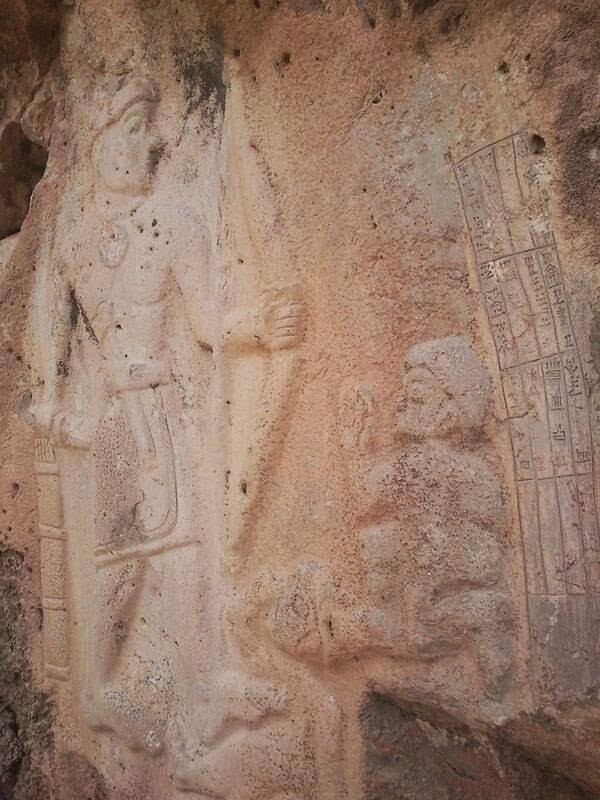
6000 year old Lord Ram and Hanuman carvings in Silemania Iraq

11072323_881266058607844_5498549039276984011_n

AN ANCIENT RAM-CHAPEL IN SUMER
One of the major triumphs of modern archaeology was the hair-raising discoveries of Sir Leonard Woolley at Ur. Amidst the ruins of Ur, he unearthed a Ram-chapel but totally missed its relevance in world history. This crucial finding not only bridges the wide gaps between Indian tradition and archaeology but also unfolds the historic bonds that once united ancient India, Iran and Sumer. Ram-Sin of (Larsa) to whose memory this chapel was dedicated must have been Rama of Valmiki. The name Ararama of Larsa may be an echo of Rama. This Ram-Chapel of Ur is the earliest known memorial to the great Rama and may have been erected by Dilmun merchants who resided nearby. Dilmun was always mentioned in the Sumerian texts together with Magan and Melukkha and it is possible that these three states were somehow allied to each other.
RAMA, BHARATA & LAKSHMANA IN SUMER
The Cambridge Ancient History[xvi][iii] which is usually not considered as a sourcebook for Indian history by writers like Romila Thapar contains priceless information relevant to Indian ancient history. In the highly authentic Sumerian king list appears such hallowed names as Bharat (Warad) Sin and Ram Sin. As Sin was the Moon god Chandra Ram Sin can be seen to be same as Rama Chandra. Bharat Sin ruled for 12 years (1834-1822 BC), exactly as stated in the Dasaratha Jataka. The Jataka statement, “Years sixty times hundred, and ten thousand more, all told, / Reigned strong-armed Rama”, only means that Rama reigned for sixty years which agrees exactly with the data of Assyriologists. Ram Sin was the longest reigning monarch of Mesopotamia who ruled for 60 years. The mention of the father in the inscriptions of both Warad Sin and Ram Sin is noteworthy and may point to a palace intrigue. Joan Oates is not aware of the Ramayana but writes with great insight (p. 61) that Warad sin was manoeuvred to the throne by his father. In Mesopotamia, a prince normally became king only after the death of his father. Lakshmana, mentioned the Bible as Lakhamar, ruled as a great king.

Sunday, February 17, 2013

English vs Sanskrit


Below is an example of the early use of  English in the Bible, spelling of 500 hundred years ago has changes every 100 years, the Americans have their own spelling the language and grammar is not logical, nor logically thought out, it just happens. Today's English will look like this in another 200 years time but not Sanskrit.

This is the boke of the generacion of Iesus Christ the sonne of Dauid the sonne also  All the generacions from Abraham to David are fowretene generacios. And fro David vnto the captivite of Babylon are fowretene generacions. And from the captivite of Babylon vnto Christ are also fowrtene generacios. The byrthe of Iesus Christ was on thys wyse. When hys mother Mary was betrouthed to Ioseph before they came to dwell to gedder she was foude with chylde by ye holy goost. The Ioseph her husbande beinge a perfect ma and loth to make an ensample of hir was mynded to put her awaye secretely. Whill he thus thought behold ye angell of ye Lorde appered vnto him in a dreame saynge: Ioseph ye sonne of David feare not to take vnto ye Mary thy wyfe. 
 Sanskrit has not changed in 2500 years and can not change for it is a mathematical language, when Panini 2500 years ago codified it. Sanskrit as Maths where studied in the same logical manner AS ONE, an example of this is Patangil,author of Mahabashya, (a comentery on sanskrit grammer) and in  Chandaḥśāstra presents the first known description of a binary numeral system in connection with the systematic enumeration of meters with fixed patterns of short and long syllables.The discussion of the combinatorics of meter corresponds to the binomial theorem.  Halāyudha's commentary includes a presentation of the Pascal's triangle (called meruprastāra). Pingala's work also contains the Fibonacci number, called mātrāmeru, and now known as the Gopala–Hemachandra number.

Saturday, October 11, 2008

Meaning of Bharat

DAIVA BHOOMI BHARATHAM, VEDA BHOOMI BHARATHAM, DEVA BHOOMI BHARATHAM, DIVVYA BHOOMI BHARATHAM, DHANNYA BHOOMI BHARATHAM, SWARGA BHOOMI BHARATHAM, PUNNYA BHOOMI BHARATHAM, PURATHANA BHOOMI BHARATHAM, SATHYA BHOOMI BHARATHAM, DHARMA BHOOMI BHARATHAM, KARMA BHOOMI BHARATHOM, THYAAGA BHOOMI BHARATHAM, SHASTHRA BHOOMI BHARATHAM, ENTE BHOOMI BHARATHAM !